The Importance of a Content Server in Digital Transformation: Centralized Management Will Be Unavoidable Within 5 Years

In today's rapidly digitalizing world, organizations are investing heavily to automate their processes and transform the way they work. However, document management remains a critical area that is not given enough priority in most digital transformation projects. While organizations try to optimize their operations, they face serious risks and inefficiencies when they do not run document management through a central system.
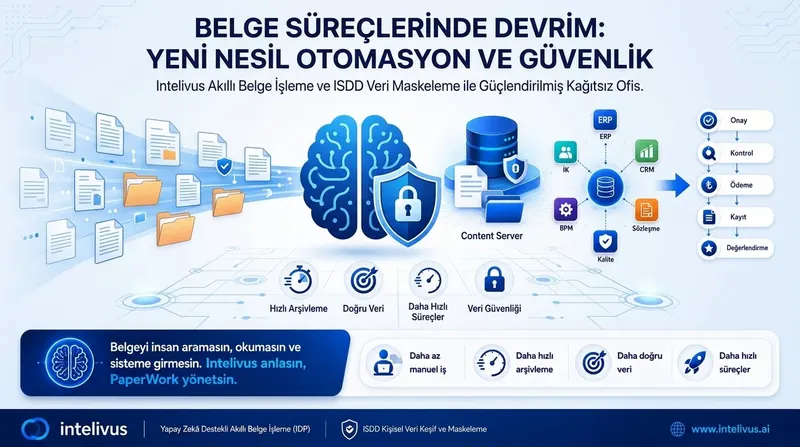
Within the next five years, managing corporate documentation processes from a single point will become a necessity for companies. A central content server (Content Server – CS) structure enables documents to be managed securely and efficiently, helping both to preserve corporate memory and to speed up processes.
The Importance of Documents Is Overlooked in Digital Transformation
Many organizations leave document management in the background while investing in systems that manage business processes, such as ERP, CRM and BPM. However, a large share of business processes depends on documents, and poor document management can cause digital transformation projects to fail.
For example:
- When critical content such as invoices, contracts, customer information, quality documents and HR documents is scattered across different systems, employees waste time accessing documents and business processes are disrupted.
- When access control cannot be enforced, documents falling into the wrong hands or unauthorized changes create a major security risk.
- Without version control, no one knows which document is the latest version, and working with wrong information can lead to serious errors.
In the coming period, companies that do not use a central content server for document management will face serious operational and legal risks.
📌 Eliminating Data Silos and Scattered Structures:
If companies keep working with documents stored on old file servers, in email attachments and on personal computers that are not integrated with their processes, the loss of operational efficiency will grow and accessing critical information will become even harder.
📌 Legal Compliance and Personal Data Security:
Data protection laws such as KVKK (Turkish Personal Data Protection Law) and GDPR contain strict rules on how documents must be stored. Managing personal data without masking, authorization and logging creates major legal risks.
📌 Integration with Digital Business Processes:
As the use of systems such as BPM, ERP and CRM increases, failing to integrate documents with these systems will slow processes down. Uploading documents manually or keeping them separately in different systems will make automation projects inefficient.
📌 Version and Access Management:
Having different versions of critical documents scattered around leads to errors and inconsistencies in business processes. With a central document management system, the version control and authorization problem disappears completely.
📌 Fast Search and Intelligent Access:
With AI-powered search engines, documents can be found in seconds. This dramatically reduces document access time, especially in large organizations, saving time and money.
Managing Documents Centrally with PaperWork's Global Content Server
PaperWork’s Content Server (CS) structure eliminates these problems entirely by enabling all corporate documents to be managed from a single center.
✅ All Applications Integrated with CS: PaperWork's global Content Server architecture enables all systems, such as ERP, CRM and BPM, to store documents in a central structure. This lets employees view and work on documents through PaperWork.
✅ Powerful Search Engine and Log Tracking: PaperWork provides fast access by scanning document content with its advanced search engine. In addition, all operations can be tracked through log records and brought into line with security standards.
✅ Version Control and Security: Document versions are tracked so the latest versions are easy to reach. Authorization mechanisms determine who can view and edit documents.
✅ Personal Data Masking and Compliance: Personal data can be masked automatically by the system, ensuring KVKK and GDPR compliance.
✅ Full Integration with Business Processes: PaperWork's Low-Code BPM infrastructure enables documents to be integrated into business processes. For example, approval processes, e-signatures and document sharing can all be run from a single system.
Centralized Document Management Is Becoming a Necessity for Companies
Within the next few years, companies that do not centralize document management will face lost efficiency, legal risks and disruptions in business processes.
PaperWork's Global Content Server structure eliminates these risks by letting companies manage their documents on a central platform. Overlooking documents in the digital transformation process will be one of the biggest mistakes threatening business continuity and competitiveness in the long run.
👉 Complete your digital transformation by starting to manage your documents centrally with PaperWork!
Sources
https://www.ibm.com/docs/en/cloud-paks/cp-biz-automation/25.0.1?topic=capabilities-content-services
https://www.ibm.com/think/topics/document-management
https://www.ibm.com/think/topics/knowledge-management
Would you like to see PaperWork in your organization?
Request a Demo