Change is too hard
When an invoice arrives for approval, we email it to the relevant department and wait for the approval email. This usually takes a few days.
Yes, it is possible to automate this process with a document management system. Change is not hard. What is hard is having the vision and showing the determination that change requires. In the example above, the approval process needs to be well designed. For instance, how much approval authority do the approvers have? If that amount is exceeded, who should approve next? What should the approval time be at each step? You should spend enough time finding the right answers to these and similar questions. Once the system is set up, the productivity gains will be remarkable.
For example, when you design your invoice approval workflow on a document management system, your costs go down. Your processes become trackable at all times within the system. The problems you face while invoices are approved by the relevant department disappear. Everything happens on time, smoothly and as planned. You are completely freed from frustrating problems such as lost invoices, not knowing whose desk an invoice is sitting on, invoices sent to the wrong department, or invoices left lying on desks where everyone can see the prices.
We can find information and documents when we need them.
When customers call, we can find the documents they need and send them over. Most of the time we cannot do this immediately. We get back to our customers within a certain time and inform them. We do not see a problem with that.
Of course, if you give them enough time, your employees will usually find the requested document and bring it to you. But because of competition, we often do not have that time. And do you have any idea how much it costs to locate these documents in in-house archives and check whether they are up to date? Likewise, untagged electronic documents stored on file servers are very hard to reach. Your documents get lost in dozens or hundreds of folders. Many electronic copies of the same document are scattered across the system, and it becomes impossible to tell which one is current. For these reasons, your employees spend 35% of their time trying to reach information. They spend the rest of their time doing their work based on that information. How efficient is it to work this way?
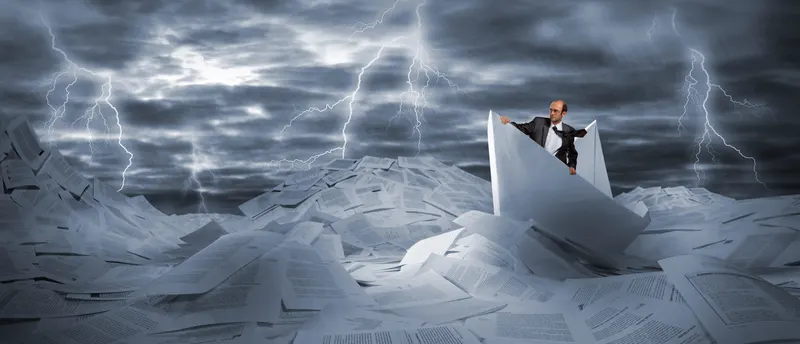
If, before it is too late, every document produced is tagged with keywords and archived electronically, the time your employees need to reach information drops dramatically. Otherwise, you end up with lots of folders full of untagged electronic documents that are very hard to access. You end up with a pile of archives in which you cannot find what you are looking for
Our employees are always busy anyway
It is normal for our employees to spend an average of 2.5 hours a day searching for and finding documents and organizing their email. These tasks are naturally part of their job.
This assumption is completely wrong. What you should expect from your employees is to make the best decisions for current conditions and to come up with new ideas that improve the work they are responsible for. Your employees should represent you at the highest level to your customers. They should spend all of their time on activities like these. If you disagree with this idea, you are on entirely the wrong track. Today's competitive, time-driven market will put you under serious pressure.
There is nothing wrong with your employees always being busy. Most people want to be busy anyway. But here we are talking about being "productively busy." They should spend their time on work that turns into revenue. It is a mistake for them to spend so much time on tasks such as finding and archiving documents that are not part of their main goals. When technology can do this kind of work far more efficiently than your employees, resisting it means standing against a changing business world. If you do not use this productivity tool, competitors who use the technology will always get ahead of you.
Nobody has ever fined us or taken us to court because we could not find a document.
If we ever have to defend ourselves, we can provide the necessary documents.
In reality, the laws governing electronic documents and archives in Türkiye are changing rapidly. Regulations in this area have accelerated considerably as part of the European Union harmonization laws. If you start using a document management system now, you will be prepared for the regulations that are coming soon. From a legal standpoint, you can also deliver any document to the authorities instantly. Such solutions keep audit logs of every action taken on the information and documents in the system. That is why using a document management solution significantly reduces your risk of ending up in an unwanted legal situation.
Actions taken on documents are especially important in insurance, legal and regulatory matters. If documents that require a response within a set period are forgotten or overlooked, your organization will face financial penalties. Electronic document management systems protect you from such unwanted situations.
Information and document management is not that critical.
Managing our financial data is very important to us, so we invest in applications such as enterprise resource planning, warehouse management, accounting and inventory management. But compared to these, managing information and documents is not critical.
Who said information and document management is not important? The only way to stand out from the competition and succeed is to make sure this information is in the right place at the right time. That way, your employees can make the right decisions with up-to-date data. Having information is useless if you cannot interpret and use it correctly.
Imagine you are working on a contract, and the document goes back and forth by email between lawyers and the colleagues involved. Everyone makes various edits. In all this confusion, you suddenly realize you worked on the wrong version and sent it to the customer. Your corporate reputation is damaged in an instant. Similarly, many unwanted situations, such as processing a transaction with an old price list or working with outdated documents, cause both financial and reputational damage to the organization.
Physically archiving a document and finding it when needed does not cost much. Our electronic documents are already on our file servers.
Yes, we are aware that archiving and finding documents, locating misfiled documents and recreating lost ones all have a cost. However, we do not think these tasks cost the company very much.
Especially in today's economic conditions, the costs arising in the situations above are very high. If a document is lost, what does it cost to wait for the time it takes to recreate it? The cost of the time employees spend reaching documents and the time spent waiting for information from others cannot be underestimated.
When we look at all these time losses across the organization, the impact on productivity is enormous. Customer service quality also declines significantly. Everything we have discussed costs the organization a great deal. These negative factors drag you toward failure without you even noticing. If you are not taking measures to correct them, the only explanations are that you are either very rich or not a company of this era.
We are not harming the environment.
So what if a document is copied 15 times on average across the organization? I have much more important problems.
Well, the moment you understand the cost of copying a document this many times for no reason, you will stop losing money. Doing nothing to prevent it will, I believe, cause you serious problems in the long run. As you fill your physical archive with these extra photocopies, before long every space will be filled with filing cabinets and you will struggle to find room for new staff.
Preventing trees from being cut down unnecessarily is also a social responsibility. Every organization must be aware of this so that the world we leave to our children is livable. Every project carried out to keep our world green is long term. Adopting technology that reduces paper consumption and uses less toner and electricity, and embracing it as part of your company culture, will make you a company that fulfills its responsibility to the environment. In the future, people will prefer the products and services of environmentally conscious companies.
We can bring everyone together for project meetings.
When we need to bring people together for a project, we first send the relevant documents to the project members in advance. After everyone has worked on them, we meet and discuss the project details.
Of course, you can still bring everyone together and hold your meetings this way. But especially when project members come from different cities, the cost of such meetings rises considerably due to items such as airfare and accommodation. It is also very hard to align everyone's calendars and gather them in one place. Your employees also lose time traveling to and from these meetings.
Advances in electronic document technologies let you hold such meetings without disrupting your employees. With tools such as webinars, GoToMeeting, email and the web, all your employees around the world can easily communicate with each other and share information. Document management systems also give all your employees a document sharing platform. So when it is this easy to bring your employees together using technology, why take the far more costly and inefficient route?
Our physical archive is safe. Nothing will happen to it.
We have taken every precaution to secure our physical archive. We will not run into any problems.
No matter how many precautions you take, you cannot guarantee that there will be no earthquake or fire. After all, your archive is made of paper and is easily affected by water, humidity, fire and time.
Problems with your physical archive do not have to come from natural disasters. You can also suffer serious data loss when a fire suppression system malfunctions and goes off by mistake, or when someone carelessly fails to put out a cigarette butt.
Once your archive has been digitized, backing it up or moving it to another location becomes very easy. You now have a "mobile archive." For security, you can easily send a copy of your archive to different cities or even countries. If you tried to do the same with a physical archive, the cost and time involved would be enormous.
Sources
https://www.ibm.com/think/topics/document-management
https://www.ibm.com/think/topics/document-workflow
https://www.ibm.com/docs/en/cloud-paks/cp-biz-automation/25.0.1?topic=capabilities-content-services
Would you like to see PaperWork in your organization?
Request a Demo