You know how there are periods in life when you become deeply curious about something? During one such period, I became fascinated by the world's turning points and revolutions. With the excitement of youth, I tried to read whatever came my way. After a while I realized I was interpreting everything I read through the lens of my own time. Once I noticed this and read it all again and again, I found I understood the needs, the events and their consequences much better.
In fact, “Digital Transformation” entered our lives in a similar way. Most people never got beyond reading academic papers. Some tried to explain digital transformation by going all the way back to the 1st, 2nd and 3rd industrial revolutions and Industry 4.0. Questions always remained, and it was never really understood until it was turned into examples. That is why it took a long time for the knowledge to spread widely.
Actually, “Digital Transformation” was understood most easily through the pandemic. Digital transformation means changing the way business is done. And in doing so, it means putting 4 core principles into practice better and more appropriately.
- Interoperability: All people and machines being related and connected to one another. Of course, this does not mean cables hanging off people as we see in science fiction films. In simple terms, it means people, machines and sensors communicating with each other. The concepts of IoT (Internet of Things) and IoP (Internet of People) were developed over time to support this approach.
- Information transparency: The ability of information systems to create a virtual copy of the physical world by enriching digital system models with sensor data. This also includes making sense of raw sensor data.
- Technical assistance: First, all systems helping people make fast and accurate decisions by collecting and visualizing information. Second, using the available data to make the work of people doing dangerous or exhausting jobs easier and safer.
- Decentralized decisions: Escalating decisions to a higher level only for exceptions, interventions or conflicting goals, while the system makes its own decisions for all routine operations. This is where the concept of Artificial Intelligence (AI) gains importance.
If we go back to the pandemic, the subject becomes easier to grasp. Companies that were not ready at the systems level ran into a series of problems because the data created centrally by people or machines could not reach the employees who needed it, in the right form and at the right time. Some adapted quickly and kept operating because they were ready in terms of vision, some lost serious amounts of money, and some still have not understood what was missing.
In the early 2010s, most companies caught up in this transformation tried to solve all their needs on ERP systems. When the ERP concept first appeared, it actually meant something very different from what it means today. The ancestor of the first ERP systems took shape from the need to write data to and read data from a central database from many different points. This provided a great deal of visibility into operations and was a breakthrough in how departments related to each other.
As the saying goes, “If all you have is a hammer, everything looks like a nail.” ERP systems met the same fate. Because the exact purpose of an ERP system was not clearly understood, companies tried to meet all their needs on these platforms. Over time, many customizations emerged that included CRM functions without being a CRM, HR functions without being an HR system, SRM (Supplier Relationship Management) functions without being an SRM, and finally MES (Manufacturing Execution System) functions without being as functional as one. Then, thanks to employees and middle managers who saw fit to impose their own way of working on the systems rather than “the Organization's Way of Working,” dozens of reports, unused screens and odd buttons on screens began to appear. A massive architecture of add-on code emerged. Over time, this architecture turned into systems that could not move to new versions of the product, did not include current technologies, and had no or limited mobile use. And of course, we should not forget the comment This ERP isn't enough for me. That is a topic for a whole other article.
Meanwhile, technologies changed, needs grew and existing ones began to change shape. Employees involved in ERP projects changed jobs or positions. Corporate memory took a hit. What runs where, and why, was forgotten. The concepts of Sustainability and Agility that are always discussed for systems suffered. Most companies decided to solve this with “New ERP” implementations. Along with all these problems, the concept of Lean ERP began to develop over time.
At this point, the BPM concept, which is actually as old as ERP, came into play. BPM architecture first became widespread in the US in the early 1980s with a structure called “Machine Flow,” which aimed to manage the machines in manufacturing plants. The original goal has not changed much: monitoring machines in the field, seeing which job is waiting on which machine, and measuring to be able to do more. Later these products evolved too, and so-called “Human Centric” products emerged. Systems that only managed machines began to communicate with people as well.
Today, BPM products have changed dramatically. Graphical process modeling, the ability to integrate with any system, electronic forms used for human interaction, rules configured on forms, and easily customizable features for performance measurement came one after another. Using integration capabilities, BPM integrated with all kinds of RPA, AI and BI architectures. What has remained constant is the ease of Measuring, Monitoring and Evaluating.
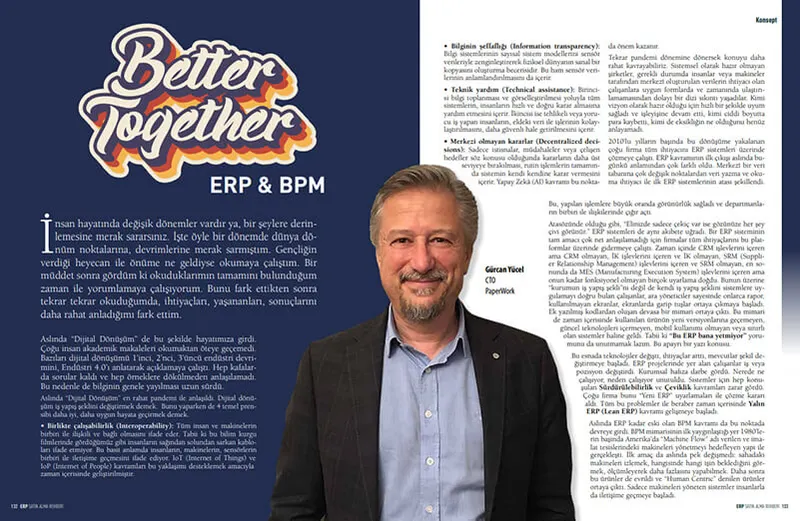
The Lean ERP concept essentially says this: avoid very complex customizations and integrations, and use the ERP system as an ERP. This platform is not a process management platform. Move your processes outside it. If possible, do not customize, except for areas subject to legal requirements. So where will the processes run? How will integrations be done? This is where BPM came in: Better Together.
A BPM platform first gives you agility. Your customizations and user interfaces come together quickly. Of course, the point to watch here is not the customization time. What matters is that customizations can be changed quickly when needed. Digital Transformation is not a project but a continuous activity: Digital transformation is a journey. During this journey you need to be very agile and able to change all of the organization's processes very quickly. Along with all this agility, you must be able to measure easily. You need instant answers to questions such as: How much work is waiting on whom, how much work can each person do, how can I optimize the work being done, and what is the status of human-machine and system-to-system integrations? Are they working? You also need to be able to quickly see and change the nature of the work, the integrations and the code through a process diagram. You need to easily bring new technologies such as RPA and AI into your architecture and be agile in terms of technology as well. Most importantly, after all these customizations, your platform must still be upgradable to new versions with current technologies.
Yes,
Better Together. This is the approach the world recommends for an organization: centralizing all ERP processes with Lean ERP, addressing as many of your processes as possible on a process platform, integrating BPM and ERP platforms with ready-made integrations wherever possible, planning your processes end to end, and measuring to always find, plan and implement areas for improvement.
Wishing you agile transformations.
Sources
https://www.ibm.com/think/topics/enterprise-resource-planning
https://www.ibm.com/think/topics/business-process-management
https://dergipark.org.tr/tr/pub/aurum/article/1105039
Would you like to see PaperWork in your organization?
Request a Demo