| Canan Ünverdi, PMP, Customer Services Manager |
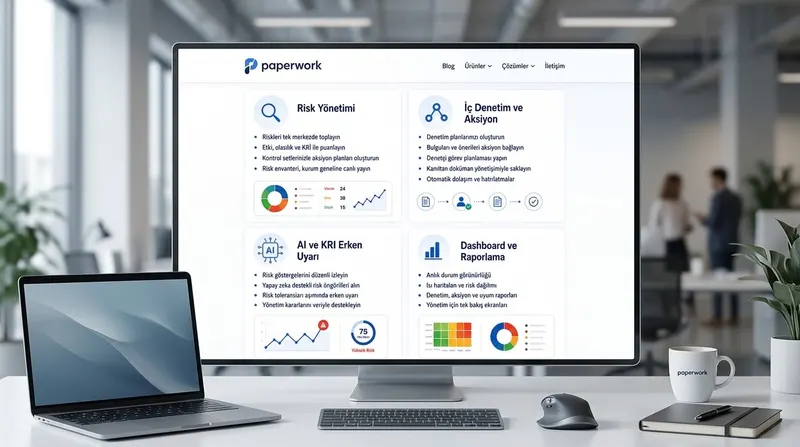
PaperWork is a Workflow and Document Management platform that integrates with every environment in your organization. With it, you can bring the strategic processes in your organization's portfolio to life, run processes linked to one another, and monitor your processes and measure their performance with an advanced reporting menu and custom reporting capabilities. With PaperWork, you can assess your portfolio together with our expert process analysts and move your organization's position upward with smart moves.
Now let's take a closer look at why portfolio management matters to an organization:
A portfolio is the full set of projects and programs an organization runs to achieve its strategic business goals.
Projects and programs in a portfolio do not have to be linked to each other, and portfolio components can cover past, current, and future projects and programs.
An organization can have more than one portfolio, each serving a separate strategy and a separate business goal.
Portfolio management is essentially the work of ensuring a balanced distribution of the organization's financial, human, and other resources across projects, taking into account the organization's priorities and capacity, and thereby maximizing the portfolio's value to the organization.
The portfolio manager is responsible for identifying, prioritizing, authorizing, managing, and controlling the projects and programs that will make up one or more portfolios. While the core job of program and project managers is to 'do the work right', the portfolio manager's job is to 'do the right work'. Deciding which projects will be carried out and how the organization's financial and human resources will be shared among them is the portfolio manager's responsibility.
PMI describes what a portfolio manager or portfolio management team must do first to succeed as follows:
. Understand the organization's strategic plan
. Define portfolio management principles for the organization's strategy
. Take into account all of the organization's projects, programs, and portfolio components
. Follow the processes approved by the organization
PMI's recommendations above can serve as a guide for how senior management views the portfolio. There are also things to be done about the components within the portfolio; a portfolio manager can steer the portfolio by seeking answers to the following questions for each project in it:
. Does this project serve the common purpose of the portfolio?
. Are we satisfied with this project's performance?
. Could this project have an adverse effect on upcoming projects?
. Which projects in the portfolio does this project depend on?
. How will the success of this project affect the success of the portfolio?
It would not be right to measure success in portfolio management by the performance of the portfolio manager alone; the organization's approach and perspective will also affect portfolio management success. According to PMI's Standard for Portfolio Management, an organization must have the following characteristics to implement portfolio management:
. The organization's managers must embrace portfolio management theory.
. Multiple projects and programs must run together.
. There must be staff with the right skills for portfolio management.
. Project management processes must be applied.
. Organizational roles and responsibilities are defined.
. There must be a communication plan for conveying business decisions to relevant stakeholders within the organization.
According to research, companies with a Project Management Office that is embedded in their corporate culture are more inclined toward portfolio management. A mature Project Management Office can involve the organization's senior management in projects, and the links between projects and their connection to the organization's business strategy can be shared with stakeholders in a structured way. While the projects an organization is currently running show where it stands, its portfolio shows where it will be in the future.
A study commissioned by PMI in 2012 also shows that portfolio management produces results that increase an organization's competitiveness in the market. (See PMI's Pulse of the Profession In-Depth Report)
Looking at the research results, we see that projects are more successful in organizations with effective portfolio management.
| Organizations with Effective Portfolio Management | Organizations with Weak Portfolio Management | |
| Projects completed on time | 68% | 50% |
| Projects within budget | 64% | 54% |
| Projects meeting business goals | 77% | 65% |
| Projects meeting or exceeding expected ROI | 62% | 48% |
Let's take a look at the Knowledge Areas defined in PMI's Standard for Portfolio Management and the processes they contain:
Portfolio Strategic Management: Aligning the portfolio with the organization's strategic goals
Portfolio Governance: Reviewing the portfolio and putting decision-making mechanisms into action
Portfolio Performance Management: Managing resource use, monitoring portfolio performance, and realizing expected value
Portfolio Communication Management: Creating a communication management plan and managing portfolio information
Portfolio Risk Management: Creating a portfolio risk management plan and managing risk
| Defining | Aligning | Authorizing & Controlling | |
| Portfolio Strategic Management | Strategic Plan is developed Portfolio Charter is prepared Roadmap is created | Strategic changes are managed. | |
| Portfolio Governance | Portfolio Management Plan is created. Portfolio is defined. | Portfolio is optimized. | Authorizing portfolio components Portfolio review |
| Portfolio Performance Management | Performance Management Plan is created. | Supply and Demand Management Portfolio Value Management | |
| Portfolio Communication Management | Communication Management Plan is created. | Portfolio Information Management | |
| Portfolio Risk Management | Risk Management Plan is created. | Portfolio Risk Management |
The Defining process group is mainly about planning: what needs to be done to keep all projects and programs in the portfolio aligned with strategy is planned. Plans are made for how performance will be measured, how stakeholders will be communicated with, and how risks will be managed. The Portfolio Charter is prepared to include high-level scope, high-level timing, success criteria, and stakeholders.
The Aligning process covers the activities carried out while the portfolio is in effect. When strategy changes, it is ensured that all components of the portfolio are consistent with the new strategy. This sometimes means a change in scope and sometimes means ending the related work. Categorizing, revising, selecting, and managing portfolio components are carried out in this process.
Under Authorizing & Controlling, the components within the portfolio are taken up and put through the approval process. The performance of the components is checked and the benefits gained are measured.
References
. PMBOK 4th Edition
. Head First PMP J.Greene, PMP&A.Stellman, PMP Translated by: Fatih Ünal, PMP
. https://www.projectsmart.co.uk/what-is-project-portfolio-management.php
. http://www.velopi.com/news/pmi-pmp-free-project-management-resource-portfolio-processes
. https://en.wikipedia.org/wiki/Project_portfolio_management
. http://www.pmi.org/~/media/PDF/Research/PMI-Portfolio-Management.ashx
. http://www.pmi-nic.org/public/digitallibrary/Assemblea%20Gen%202013%20-%203.%20Portfolio%20Management%203rd%20Edition.pdf
. http://searchcio.techtarget.com/definition/PPM-project-and-portfolio-management
. https://www.pmi.org/Business-Solutions/~/media/PDF/Business-Solutions/Value%20of%20Project%20Management_FINAL.ashx
Sources
https://hbr.org/2026/01/the-project-driven-organization
https://dergipark.org.tr/tr/pub/huniibf/article/443498
https://dergipark.org.tr/en/download/article-file/517196
Would you like to see PaperWork in your organization?
Request a Demo