| Fevzi Öztürk, Operations Director |
Content update: PaperWork, September 6, 2026.
What is process management?
Process management is an approach to defining, monitoring, and improving how work starts in an organization, which tasks and approvals it goes through, who is responsible, and what result it ends with. Business process management (BPM) looks at this work through end-to-end operations rather than a single task.
A workflow shows the sequence and rules of tasks; process management also covers the goal, performance, and improvement of that flow. For example, sending a leave request for approval is a workflow. Measuring approval time, finding the causes of delays, and improving the flow according to the leave policy are part of process management.
Why do you need a process management system?
When work runs across email, spreadsheets, and different applications, responsibilities and pending steps can become invisible. A process management system brings tasks, data, documents, and business rules together in a shared flow so that departments work on the same process.
The expected gains are fewer unnecessary steps, clearer responsibilities, and visible process performance. Results depend on the process scope, data quality, integrations, and user adoption. The improvement rate should be calculated by comparing the same metrics before and after implementation.
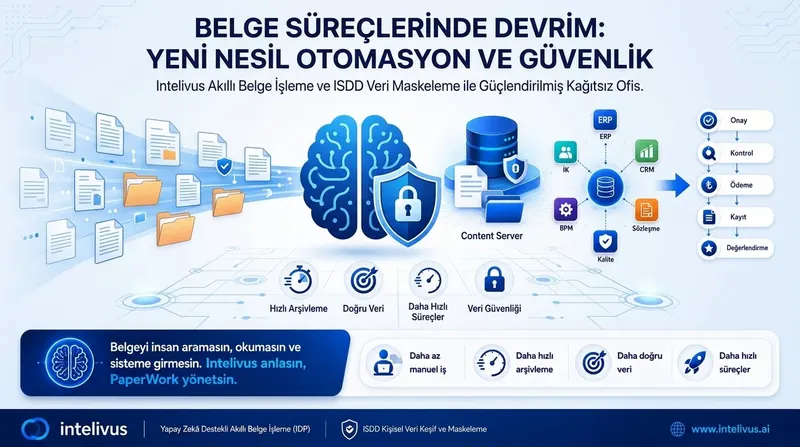
A process management system can work together with existing ERP, CRM, and other enterprise applications. The aim is to use existing data and transactions within the process, reducing duplicate data entry and gaps between applications. PaperWork integration capabilities help assess this scope.
Integration of Enterprise Data and Systems
Organizations use process management systems to increase and speed up interaction with their other existing systems through workflows, as a user interface and reporting tool for those systems, and to define and run business rules.
Standardization and Agility of Business Processes
Process management systems provide the methods and tools needed to automate business processes. These methods and tools make it possible to standardize and speed up business processes and to make quick, real-time changes to them.
Reducing Bottlenecks
Process management systems increase the traceability and transparency of business processes. This makes it possible to take the necessary measures in core business processes and helps reduce costs.
Improving and Speeding Up Communication
Process management systems improve and speed up communication between departments, suppliers, and customers. Suppliers and customers can communicate seamlessly with the organization's departments.
What are the goals of process management?
The core goal is to track work from start to completion and improve its quality, duration, and use of resources.
Efficiency
Real-time information flow in process management systems makes analysis and reporting easier and brings efficiency to decision-making.
Reducing Costs
Identifying bottlenecks and transparently monitoring and measuring processes provide information for the improvements needed and help reduce costs.
Quality and Standardization
Improving and standardizing quality in business processes is the most important goal of a process management system. Process management software lets organizations measure their process quality against competitors in their industry, helping improve quality and competitiveness.
Extending Decision-Making Across the Organization
Process management systems spread decision steps in processes across the entire organization. They also improve decision-making by giving all departments involved in enterprise processes, such as procurement, finance, accounting, and human resources, access to the same data and processes.
How is a process management system implemented?
Strategic planning
. Form a team from all departments within the project scope
. Review existing processes and information flows
. Review the capabilities of the process management software for their impact on daily work in the new system
. Set a goal for the project
. Create a project plan
Reviewing Processes and Procedures
. Review all features of the process management software and identify gaps that need to be filled with other methods
. Identify processes that are run manually and need to be systematized
. Write the procedures to be applied as standard for the processes you have identified
Data Collection and Data Cleansing
. While analyzing current processes, determine which information is really needed
. Determine what new information needs to be collected in processes
. Review the data you have collected and clean out what is not really needed
Using Process Improvement Methods
. To improve enterprise processes, use a structured process improvement technique of your choice to identify value-added activities, reduce unnecessary activities, and speed up transactions
Training and Testing
. Prepare scenarios to test the accuracy of the data you have collected
. Check that your scenarios are consistent with the procedures you have written
. Have the project team test the accuracy of the processes you designed and the required information
Go-Live
. Once configuration, development, and testing are completed in line with your preparations, you are ready to take your process management system live
. Prepare an objective evaluation plan to measure whether your aims and goals are achieved in user acceptance testing
Continuous Improvement
. In this final stage, you should prepare a plan for continuous improvement
. For continuous improvement, review and measure processes at regular intervals to gauge process efficiency and identify improvement opportunities
Advantages and implementation challenges of a process management system
Advantages
. Process management systems have a flexible and extensible structure. Adding new features and processes is very easy
. Because they provide real-time information and traceability for business processes, process management systems reduce management and operating costs
. Process management systems improve the quality of decision-making by providing transparent and objective data about processes
. Process management systems increase data access security with their advanced user authorization structures
. Process management systems bring transparency to enterprise processes
. Process management systems provide high security by ensuring employees take part only in the processes relevant to them and access only the related data
. Process management systems provide ease and flexibility in process reporting
Disadvantages of Process Management Systems
. The resources and investment needed to implement a process management system can be high for small and medium-sized organizations
. Implementing a process management system can take a long time, depending on scope
. Process management systems can be complex for multiple organizations because their organizational structures differ
How is success measured in process management?
At the start, define the measurement period and the process owner. You can track completion time, waiting time at each step, the share of work completed on time, records that require rework, and open workload. When comparing different periods, consider changes in work volume and process scope together.
. A process management system gives organizations the opportunity to speed up and improve business processes
. The main goal of a process management project is to monitor and improve enterprise business processes
. Improving quality in enterprise business processes is the most important aim of a process management system
. A process management system makes real-time monitoring and reporting of processes and process data easier
Process management with PaperWork
PaperWork brings electronic forms, task and approval steps, documents, and enterprise system transactions together in the same process. To define the scope of implementation, you can review the process automation solution. To explore the concepts and task sequences in more detail, see the what is a workflow guide.
Sources
https://camunda.com/blog/2024/04/what-is-business-process-management/
https://www.ibm.com/think/topics/workflow
https://www.ibm.com/think/topics/workflow-automation
Would you like to see PaperWork in your organization?
Request a Demo