Why Are Integrated Low-Code Platforms Inevitable?
Many companies setting out on their digitalization journey move forward with good intentions but the wrong strategy: buying a separate application for every job.
One software for expense management, a separate solution for customer requests and for invoices, another system for documents, a separate one for quality, another for risk, email for approval processes…
At first this approach seems fast and low-cost. But over time, the picture companies face is almost always the same.
A Separate App for Every Job: A Silent Source of Inefficiency
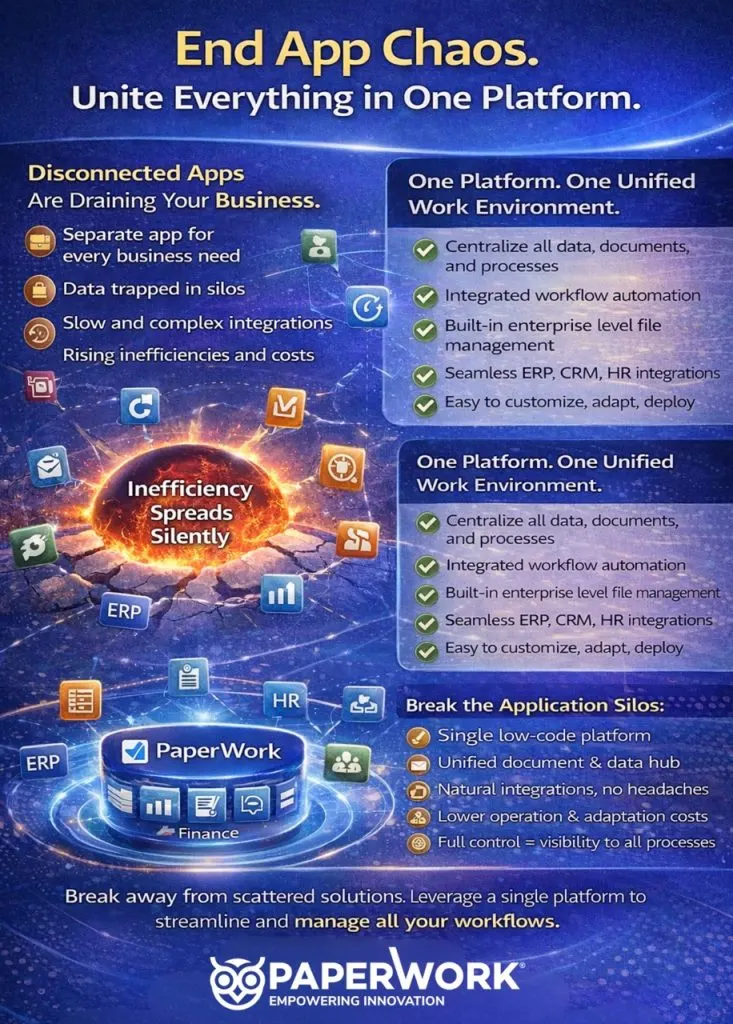
A fragmented application architecture:
- Forces users to jump between different interfaces
- Buries IT teams in integration projects
- Causes each system to keep its own data and documents
- Makes "access to the right information at the right time" harder
The most dangerous part is this: the inefficiency spreads not loudly, but silently.
No one openly says "our systems don't work". But work slows down, decisions are delayed, errors increase and costs rise.
The Integration Fallacy: Connecting Is Not Enough
Most organizations try to solve this problem with integration projects. But integration doesn't eliminate the fragmented structure; it only hides the complexity.
- Data updated in one system reaches the other late
- Documents are copied and versions multiply
- It becomes unclear which information is "correct"
- Integration costs rise with every new need
In the end, companies find themselves managing applications in order to manage applications.
The Real Problem: The Lack of a Platform
The problem is not the number of software products but the lack of a platform.
What companies need is an infrastructure that manages:
- Processes
- Documents
- Data
- Business applications
within the same architecture, naturally connected to one another.
PaperWork was born precisely from this need.
PaperWork: An Integrated Approach Instead of Fragmented Applications
PaperWork is an integrated low-code platform that combines BPM, document management (ECM), low-code application development, integration and artificial intelligence on a single platform.
PaperWork's approach is clear:
Instead of separate applications, vertical solutions running on the same platform.
This way, all business areas such as quality, risk, expenses, suppliers, contracts and human resources share:
- The same data model
- The same document repository
- The same process engine
in common.
The Real Advantages of a Single Platform
1. A Single Source of Data and Documents
Data and documents are created once and called from anywhere. No copies, no version chaos.
2. Processes Are Not Disconnected
A quality nonconformity is linked to a risk, a risk turns into an audit action, and supplier performance is associated with a contract.
Everything is connected.
3. Lower IT Burden
When a new need arises, no new software is bought. It is adapted on the PaperWork low-code infrastructure.
4. Real-Time Visibility
Processes are measured and performance is monitored in real time. Management decides based on data, not intuition.
5. Ready for the Future
While today's needs are met, the infrastructure is ready for the new business models that will emerge tomorrow.
Why Are Cheap Quick Fixes Dangerous?
Solutions that look low-cost in the short term:
- Turn into an integration barrier a year later
- Stand in the way of change two years later
- Slow digital transformation down completely three years later
At that point, companies either have to replace the system entirely or accept living with inefficiency.
Conclusion: Digital Transformation Is a Platform Matter, Not an Application Matter
Digital transformation is:
- Not buying more software
- Not doing more integrations
- Certainly not building more complex architectures
It is choosing the right platform.
PaperWork helps companies:
- Simplify today's operations
- Easily meet tomorrow's needs
- Make efficiency permanent
It is an integrated low-code platform designed for exactly this.
It is possible to get through the day with fragmented applications. But sustainable success is only possible with integrated platforms.
Don't decide before you see PaperWork.
Sources
https://www.ibm.com/think/topics/saas-sprawl
https://www.ibm.com/think/topics/api-integration
https://www.ibm.com/think/insights/data-integration-challenges
Would you like to see PaperWork in your organization?
Request a Demo