Things are changing fast in manufacturing: customer demands are diversifying, supply chains are getting more complex, and competition is intensifying. In this environment, does it still make sense to rely on heavy, slow, and expensive ERP systems set up years ago?
The answer is clear: No.
In today's competitive manufacturing environment, BPM (Business Process Management) low-code platforms have started working integrated with ERP systems, reducing the load on ERP and increasing its flexibility. The reason is simple: these new-generation solutions are more flexible, faster, and can be shaped around your business.
Below, we explain clearly why BPM and low-code platforms are a better choice for manufacturing companies.
1. ERP Is Not Flexible, While Production Processes Change Every Day
ERP systems are built on fixed structures. In production, however, everything is variable: shift plans, machine downtime, order volumes, quality control criteria… Adapting to these changes with ERP is heavy and costly.
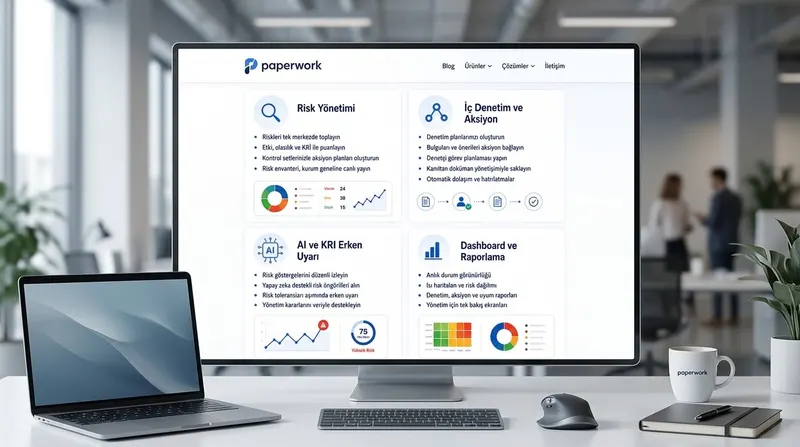
The PaperWork low-code BPM platform lets you model your production processes exactly as they are. Approval mechanisms, maintenance plans, supplier tracking processes: all of them can be digitized with BPM specifically for you. Thanks to the low-code architecture, business analysts can quickly develop custom applications for your production line without depending on IT.
2. Setup in Weeks, Versus ERP Projects That Take Years
ERP projects often turn into a nightmare for manufacturing companies. Implementations lasting 12–18 months can disrupt production processes. That means lost time and money.
With BPM and low-code solutions, you can build digital workflows that can go live within weeks. Rapid prototyping and step-by-step development save time and give you the chance to test the system in a live environment.
3. More Affordable Solutions to Lower Production Costs
ERP systems strain budgets not only with licenses but also with consulting, integration, and training costs. For small and medium-sized manufacturers, the return on investment can take years.
BPM and low-code systems, on the other hand, offer modular pricing. You can start small and expand as you see the benefits. In addition, changing the system does not require rewriting software as in ERP; additions are made on top of the existing process.
4. Real-Time Response Capability = Competitive Advantage
In production, downtime, quality problems, or supply disruptions must be resolved quickly. Changing processes in ERP systems is complex and slow.
With BPM, for example, you can:
- Instantly change a downtime reporting process,
- Add conditional approval workflows for products that pass quality control,
- Quickly collect maintenance requests from the field with mobile forms.
All of this gives you the ability to respond in real time. It speeds up production and reduces losses.
5. Easy Integration: Compatible with Machine Data, IoT, MES, and More
Modern production facilities use a wide variety of systems: MES (Manufacturing Execution Systems), IoT devices, PLC systems, quality software, Excel files…
ERP struggles to integrate with these systems or generates high consulting costs.
BPM and low-code platforms, by contrast, are designed for easy integration. With web services, APIs, and ready-made integration modules, data flows smoothly across your production line.
6. Real Use on the Shop Floor: User-Friendly Interfaces Instead of Complex Screens
ERP screens are usually too complex for use on the shop floor. Operators and maintenance staff stay away from these systems.
Interfaces built with low-code can be designed to be simple, mobile-friendly, and easy for field users to understand. As a result:
- Operator errors decrease,
- Data entry speeds up,
- Usage rates increase.
7. Infrastructure Suited to a Culture of Continuous Improvement
Approaches such as Lean manufacturing, Kaizen, and 5S are now essential for manufacturing companies. But applying these philosophies requires flexible systems as well.
Changing processes in ERP systems is difficult. With PaperWork BPM's low-code infrastructure, you can:
- Analyze the process and see the bottleneck,
- Make updates instantly,
- Achieve continuous improvement through trial and error.
The Manufacturing Company of the Future Is Flexible and Fast
Using only an ERP system was the solution of the past. In today's manufacturing world, the winners are companies that adapt quickly to change and shape their own processes.
BPM and low-code platforms give you:
- Faster development,
- Lower cost,
- Higher efficiency,
- Happier employees and customers.
Break free from ERP dependency. Increase your flexibility
Start today by digitizing a single production process. See the process, test the value, then scale up. The future will be shaped not by ERP, but by platforms that deliver flexibility and speed.
Sources
https://dergipark.org.tr/tr/download/article-file/3488966
https://www.ibm.com/think/topics/digital-workflow
https://www.ibm.com/think/topics/process-optimization
Would you like to see PaperWork in your organization?
Request a Demo