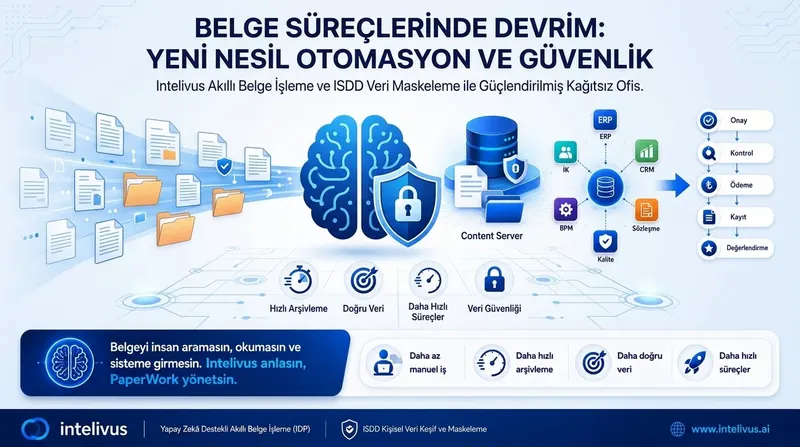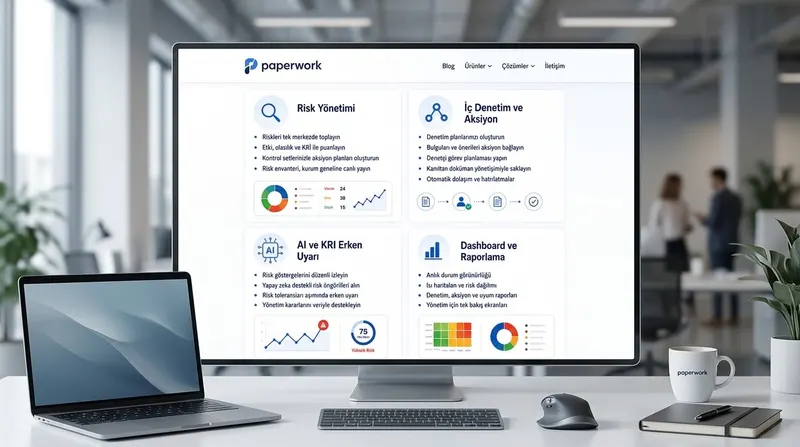
Regardless of an organization's size and culture, Document Management should be treated and handled as a corporate process in every organization. In fact, it is hardly possible to talk about document management without touching on workflows. That is why many reputable companies that positioned themselves as Document Management solution providers have had to evolve along the way and expand their solutions to cover both areas.
When we examine the lifecycle of a document used within an organization, we see that it goes through certain operations and gains capabilities…
1. Being brought into the ecosystem by being created or acquired
2. Being classified
3. Being indexed so that it can be easily searched for and found
4. Being associated with security levels so that only authorized people can access it
5. Being distributed to the relevant parties, departments and/or people
6. Being changed as these parties need,
a. Preserving the original version of the document
b. Being able to track the changes made (versioning)
c. Being able to make these changes in a sequence (workflow)
7. Being retired when it reaches the end of its intended life (retention)
… in other words, we realize that it truly lives.
Planning this lifecycle is as important as planning a baby's future, and requires the same care and attention.
Imagine having hundreds or even thousands of document types whose future you need to think about, or imagine having hundreds of children to raise. If you are in such a situation, you definitely need a plan and a strategy.
. The best first step in creating this strategy may be to structure it as a project. Within this project, it may be possible for our organization to:
. Analyze the document inventory,
. Identify the critical document types that play a role in our value chain and build the document type tree,
. Establish the governance framework that will keep the lifecycle of this tree and its members under control.
Once the governance framework takes conceptual shape, the target we are trying to reach on the horizon becomes a little clearer. Depending on the situation, the work steps that will take us there and the business processes that need to be designed and/or updated may number anywhere from a few to a few hundred. Once we have this information, we are in a good position to settle on the right project lifecycle approach.
The deciding factors in this choice are the uncertainty about requirements and the complexity of the tasks our goal requires. The diagram above was used in the Project Management Body of Knowledge (PMBOK) guide published by PMI (Project Management Institute) to highlight these factors. Where uncertainty and complexity are high, we need an effective risk management practice.
In environments where tasks are simple and requirements are clear, linear methods such as ’Waterfall’ are effective, while in environments where these are relatively high, adaptive methods such as ’Agile’, ’Scrum’ and ’Kanban’ can deliver better results. In addition, although methods focused more on process quality, such as ‘Lean’ and ’Six Sigma’, are not covered by PMI (Project Management Institute), there are examples where they are positioned as project management methodologies.
Whichever project management lifecycle we choose, without exception we must commit ourselves to ‘continuous improvement’ and, whatever we do, always stay within the PDCA cycle.
This cycle
. Plan
. Do
. Check
. Act
involves these actions following one another and repeating continuously.
Whether we structure it in small steps or larger leaps, our direction should always be toward greater effectiveness.
Thinking of and designing our document management and workflow management effort as a ‘Program’ from the very start opens the way to globally accepted, proven Project Governance structures and lays the groundwork for reaching our goals with ease.
Sources
https://dergipark.org.tr/en/download/article-file/517196
https://www.ibm.com/think/topics/business-process-analysis
https://www.ibm.com/think/topics/process-mapping
Would you like to see PaperWork in your organization?
Request a Demo