In most organisations, signing a contract is seen as the end of the process. Yet the real responsibility starts at exactly that point.
Payment terms, delivery dates, price updates, service levels, guarantees, penalty clauses, renewal and termination dates… The value a contract brings to the organisation depends on how well these obligations are tracked.
But when contracts are kept in different folders, emails and on employees' computers, control becomes increasingly difficult. After a while, the organisation has many signed contracts but cannot clearly answer these questions:
- Which contract is about to expire?
- Are the commitments we have given and received being fulfilled on time?
- Have different terms been accepted in similar contracts?
- Did we use our price increase or renewal right on time?
- Were risky clauses noticed before signing?
- Which is the current version of the contract?
- How quickly can we reach the information needed in a dispute?
This uncertainty is not only the legal department's problem. Procurement, sales, finance, operations and senior management are also affected by the consequences of the same contract.
Archiving contracts is not managing contracts
Storing contracts digitally is an important step. But having documents in a folder does not mean they are being managed.
Real contract lifecycle management should cover every stage, starting from the contract request through drafting, negotiation, approval, signature, obligation tracking, renewal and termination.
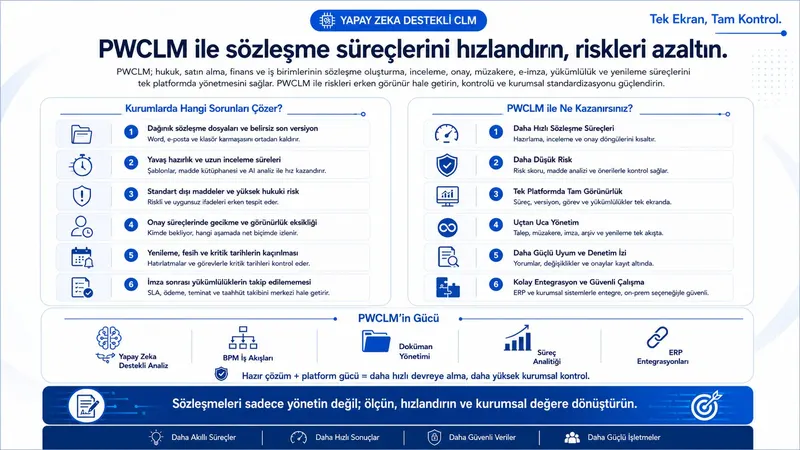
PWCLM treats a contract not just as a stored document but as a living business process. It manages the tasks, approvals, correspondence, versions, risks and obligations related to the contract within the same structure.
This way, the history of a contract does not depend on a few people's memory or scattered email chains.
What does AI change in contract management?
One of the most time-consuming parts of contract management is reading long texts and extracting critical information one by one.
PWCLM's AI support reviews contracts and helps important clauses and dates to be noticed faster. Payment terms, durations, the parties' obligations, guarantees, penalty provisions, renewal and termination clauses become visible.
AI can also:
- Summarise the contract.
- Flag critical clauses and possible risks.
- Show changes between different versions.
- Warn the user about missing or non-standard provisions.
- Make it easier to compare similar contracts.
- Turn contract data into reportable information.
The aim here is not to replace the lawyer or contract manager. The aim is to reduce repetitive review work and allow experts to spend more time on issues that truly require assessment.
The final decision is still made by a person; but the information they need to decide is now more organised and accessible.
A process that doesn't get lost between Word files and email chains
When a contract is being prepared, different Word files are often created. Files are shared by email, clauses are changed, and soon it can become unclear which version is current.
In PWCLM, a contract draft can be prepared using the organisation's approved templates and clause library. Legal, finance, procurement and the relevant business units can give their opinions within the same process. Changes and approvals are kept on record.
Thanks to the built-in editor, every step from preparing the contract to sending it for electronic signature can be carried out on the platform. This reduces the need to take the document outside the organisation in an uncontrolled way, protects version integrity and makes the process more secure.
Don't lose control after signature
Many contract management projects focus on the signing stage. Yet a significant part of the financial losses organisations face arise after signature.
An unused price adjustment right, a forgotten termination deadline, an expired guarantee, an untracked service level or a contract that renews automatically can have direct financial consequences.
PWCLM links the obligations in signed contracts to tasks and calendars. Owners, deadlines and actions to be completed are defined. Automatic reminders and, when needed, escalations are created for upcoming dates.
The contract stops being a file sitting only in the legal department's archive; it becomes a living business record managed together with the related teams' tasks.
Everyone reaches the same information, as far as their permissions allow
Contracts often contain commercially sensitive information. That is why permissions matter as much as ease of access.
PWCLM runs on the PaperWork Content Server infrastructure. Contracts and their attachments are stored centrally; their versions, access history and transactions are recorded. Users can only reach the contracts and information they are authorised for.
This protects information security while eliminating time-wasting questions such as "Who had the contract?" or "Which was the latest file?"
What does contract data tell management?
Contracts hold very valuable information about the organisation's customers, suppliers, revenues, expenses and risks. But as long as this information stays inside document texts, management cannot use it.
PWCLM makes contract data visible through dashboards and reports. Management can track on a single screen:
- Upcoming renewal and expiry dates,
- The total value of contracts,
- Delays in approval processes,
- Distribution by department and contract type,
- Open obligations,
- Risky contracts or those containing exceptions.
This visibility doesn't just speed up operations. It grounds many decisions in stronger data, from procurement negotiations to budget planning, from supplier assessment to risk management.
Bring contract processes together without replacing existing systems
Contract management is not an application that works on its own. Customer information may be in the CRM, supplier and payment information in the ERP, and employee information in the human resources system.
PWCLM can work integrated with SAP, Oracle, Microsoft Dynamics and similar enterprise applications. The necessary information is taken from the related systems, used in the contract process, and the required results are sent back to these systems.
This way, the same information is not entered into different applications again and again. Errors decrease, the process speeds up and contract management stays connected to the organisation's operations.
Start ready-made, develop to fit your organisation
Every organisation's contract types, approval structure and risk approach are different. That is why a rigid software model is often not enough for contract management.
PWCLM runs on PaperWork's AI-powered low-code BPM, document management, case management, process analytics, business intelligence and integration infrastructure.
Organisations can make a quick start with ready-made contract management capabilities, then develop their forms, processes, rules, reports and integrations according to their needs. And when business conditions change, they don't have to wait for long software projects for every adjustment.
What does PWCLM bring to organisations?
With PWCLM, contracts are prepared faster, approval processes become traceable and risks are noticed earlier before signature.
After signature, obligations, renewals and critical dates are tracked systematically. This helps reduce revenue losses, unnecessary costs, delays and compliance risks.
Most importantly, it allows legal, procurement, sales, finance and operations teams to work on the same contract with the same information.
Don't just store your contracts, manage their value
A contract that is not managed well may not protect the organisation even if it is signed. It can even become the source of hidden costs and risks.
PWCLM manages the entire lifecycle on a single platform, from creating the contract to completing the obligations after signature. AI brings out the information hidden inside contract texts, makes risks more visible and helps teams make decisions faster.
Because the real purpose of contract management is not to archive more documents, but to keep the promises made, the risks taken and the value expected under control.
With PWCLM, your contracts don't wait in files; they keep working for your organisation.
Would you like to see PaperWork in your organization?
Request a Demo