
Lower costs, faster processes, fewer errors. When an AI project starts, expectations always revolve around these three. But a few months later the picture usually says something else: there is an impressive demo, but no system that is really used.
BCG's 2024 research shows this in numbers: nearly half of companies are still in the proof-of-concept and pilot stage, about one in five have started to generate some value, and only around one in twenty have achieved truly measurable results. McKinsey's 2025 data paints a similar picture: the vast majority of companies say they use AI in at least one area, but the overwhelming majority of executives do not yet see a tangible impact on company profits.
The reason is usually not a failure of the model. One of the three points below, and often two of them, are missing.
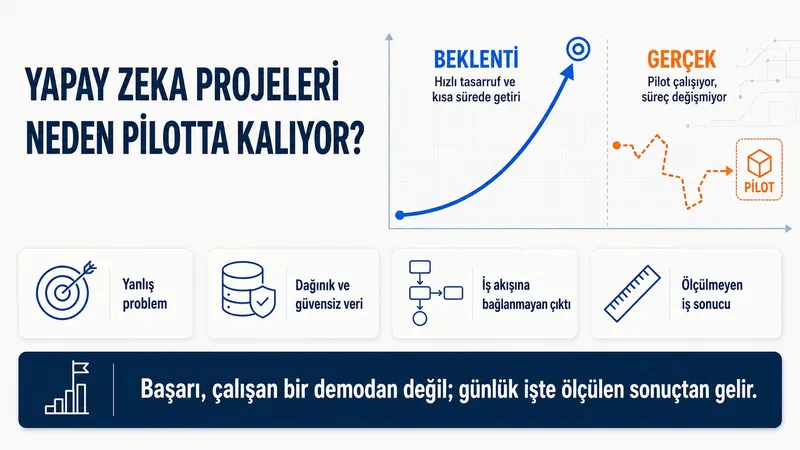
Technology is chosen before the problem is defined
"Let's use AI in customer service" sounds like a goal, but it actually says nothing. Will response times get shorter, will request classification be automated, or will the returns process speed up? These are completely different projects, requiring different data and different success criteria.
In RAND Corporation's interviews with 65 experienced experts, this is exactly the most common problem: the business unit and the technical team define the problem to be solved differently from the start. A large share of the interviewees say the real source of failure is not technical shortcomings but leadership decisions and expectations.
Projects that work usually start with a sentence like this: "The accounting team checks thousands of invoices by hand every month, spending an average of six minutes per document, and our goal is to shorten this time significantly." When the process, volume, problem and measurable goal are clear, choosing the technology becomes easier on its own.
Output is produced but connected to nothing
This, I think, is the most overlooked part. Even if the model works correctly, nothing really changes if the result it produces stays on a separate screen. The employee still copies the information, forwards it by email and enters the result into another system by hand.
To make it concrete: if no approval step opens automatically for the relevant manager when a purchase request exceeds the budget limit, if no notification goes to the procurement team when stock falls below the critical threshold, that system is really no more than a reporting tool.
According to McKinsey's data, only 21 percent of companies using generative AI have redesigned their workflows for this technology, yet this is one of the practices most strongly associated with financial impact. At PaperWork we put this point at the foundation of the platform: instead of showing its suggestion on a separate screen, AI directly triggers the related approval or transaction step. When a user types "my open tasks" in Teams, they get a real transaction screen, not a text summary.
There is no measurement, so progress isn't visible
The sentence "The model works with 94 percent accuracy" means nothing on its own. Where does the remaining 6 percent go wrong, and what does that error cost the company? If the processing time, error rate and rework cost before the project are not recorded, it cannot be understood later whether there was any real improvement.
In McKinsey's research, fewer than one in five companies track a defined performance indicator for their generative AI applications. IBM's study of 2,000 CEOs also shows a striking contradiction: 64 percent of CEOs admit that the fear of falling behind leads them to invest in technologies whose value they don't fully understand, yet most of the same group believe they will see a return on these investments by 2027. Without measurement, there is no way to verify this belief.
Where to start
Choosing the company's most complex decision for the first project means unnecessary risk. A better starting point is high-volume, repetitive work whose results can be measured and that is open to human approval when needed. Areas such as document classification, data extraction and request routing often fit this description.
But whichever area is chosen, you shouldn't move on to choosing a model before three questions are answered: How is this work done today, which transaction will the output start, and how will the result be measured? If there are no clear answers to these questions, it is still too early to choose the technology.
Sources: BCG, "Where's the Value in AI?" (2024) · McKinsey, "The State of AI" (2025) · RAND Corporation, "Why AI Projects Fail and How They Can Succeed" · IBM 2025 CEO Study
Would you like to see PaperWork in your organization?
Request a Demo