When a company talks about contracts, the legal department usually comes to mind. A draft is prepared, a few rounds of revisions are made, the signatures are completed and the document is put away in the archive. On paper, the process seems finished.
In reality, a contract does not end on the day it is signed. That is the day it begins.
Price terms, renewal dates, termination notices, guarantee periods, SLA commitments, penalty clauses, delivery obligations and the parties' responsibilities keep working after signature. When this information is not tracked, the contract stops being a document that protects the company and becomes an area of hidden cost and risk.
WorldCC's contract management research states that poor contract management can cause an average annual value loss of around 9 percent in companies, and that this can rise to 15 percent or more in more complex structures. This loss doesn't have to come from a single big mistake. Missed renewals, discounts that were never applied, untracked SLAs, vague liability clauses and commercial obligations noticed too late lead over time to the same result: the value written in the contract is not fully reflected in business results.
Why is a contract process run with Word, email and folders fragile?
In many organisations, the contract process still runs in a familiar way. The draft is prepared in a Word file. Revisions go back and forth by email. The final version is saved to a shared folder. Approvals sometimes stay in email chains, sometimes in messaging apps, sometimes in meeting notes.
If the number of contracts is small, this structure can be managed. But as volume grows, the same questions come up again and again.
- Which is the latest valid version?
- Which clause did the other party change?
- What comment did legal make?
- Has finance approved it?
- Who is the signature waiting with?
- When will this contract be renewed?
- Who will take action if the SLA is breached?
If the answers to these questions are being searched for in people's inboxes, file names or Excel trackers, the process is not actually being managed; people are trying to keep track of it. The difference matters. Tracking helps you notice something after it has slipped. Management makes risk and work visible in time.
The real need in contract management is not an archive but a control layer
Storing contracts digitally is not enough on its own. A document management system makes it easier to find the document, but it does not manage the risks, obligations and decision points inside the contract by itself.
What organisations need today is broader. Contract requests should be standardised, drafts should be created from the right template, clauses accepted by the organisation should be used, the other party's changes should be analysed, risky wording should be flagged, approvals should move through a workflow, signature status should be tracked and, after signature, obligations should be followed live.
That is why modern contract management is no longer just the legal department's filing work. It has become a shared control area for procurement, finance, sales, operations, supplier management and senior management.
A guarantee date missed in a supplier contract affects finance. A vague SLA clause puts operations in a difficult position. An unlimited liability clause creates legal risk. An automatic renewal clause can increase procurement costs. If contract data is not visible, these risks are spread across departments and are often noticed late.
PWCLM turns the contract into a living business record
PWCLM – PaperWork Contract Lifecycle Management is an AI-powered contract intelligence platform that manages the contract lifecycle end to end.
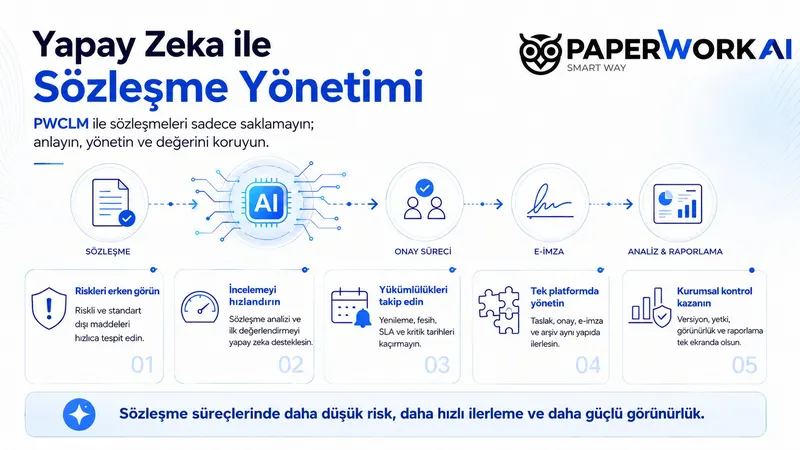
The difference here is not just that the contract is recorded. PWCLM treats the contract as a business process from the moment it is requested. Draft, clauses, versions, comments, approvals, risks, signature, obligations and renewal are managed within the same structure.
The contract is tracked not as a file, but like a case moving through the organisation. Who it is waiting with, which stage it is at, which clause was changed, which risk was identified and which action was started all become visible.
This structure makes legal teams' work easier, but its impact doesn't stop at legal. Procurement tracks supplier terms better. Finance follows payments, guarantees and penalty clauses. Management can see the risk and performance of the contract portfolio. Business units don't have to search through email chains to learn why a contract is waiting.
AI doesn't just summarise the contract; it flags the risky points
Contract review is demanding work because risk often hides not in the whole text but in a single clause. Sometimes the liability cap is not written as expected. Sometimes the termination notice period is outside the organisation's standard. Sometimes a payment term is incompatible with the structure operations accept. And sometimes two clauses contradict each other.
PWAI Assistant, at the heart of PWCLM, analyses contracts with this in mind. It splits incoming Word or PDF contracts into clauses, assesses them against the organisation's playbook and flags risky or non-standard wording. It can create a reasoned risk score for each clause and offer an alternative clause or redline suggestion.
The important point is this: AI does not decide in place of the lawyer. It makes the review desk more organised. It tells the lawyer "pay particular attention to these clauses in this contract", shows the reasoning and makes a suggestion. The decision is still made by a person.
This approach positions AI not as an uncontrolled automation tool, but as evidence-based decision support. This is where the difference emerges, especially for legal and procurement teams with heavy contract volumes. The first reading is done faster, critical clauses become visible earlier and non-standard wording reaches the table before signature.
A playbook takes knowledge out of people's heads
Every organisation has written or unwritten red lines on contracts. Which liability cap is acceptable? Which penalty clause is a risk? Which confidentiality clause must remain unchanged? Which wording is preferred on intellectual property, KVKK (personal data protection), termination, guarantees and SLAs?
This knowledge often lives in the memory of a few experienced people. When the team is busy, when a new employee joins the process or when different departments prepare their own contracts, the standard can break down.
In PWCLM, the playbook and negotiation guide make this knowledge part of the system. Preferred clauses, acceptable alternatives and red lines are defined. AI checks the contract against these rules. This way, the organisation's contract approach does not change from person to person.
This feature is especially important for holding companies, multi-company structures, organisations with wide supplier networks and teams producing contracts in different countries or departments. Because the problem is not just the growing number of contracts; it is being able to maintain the same contract standard everywhere.
Without post-signature tracking, contract value cannot be protected
When a contract is signed, most teams relax. Legal closes the file, procurement turns back to the supplier, operations starts the work. But the value of a contract is protected or lost after signature.
If there is an SLA breach in a service contract, it needs to be tracked. If a letter of guarantee is about to expire, a task should fall to the relevant person. If there is a specific date for a termination notice, relying on a calendar may not be enough. If there is an automatic renewal clause, the organisation should see it in time, not in the last week.
PWCLM treats this area as a natural part of the contract lifecycle. Renewal, termination, payment, guarantees, SLAs, delivery and other obligations are tracked centrally. Owners, dates and actions are managed within the process.
This way, the contract does not become a passive document put away in the archive after signature. It becomes an active control record that tracks the organisation's commitments and the other party's obligations.
Process analytics makes the workload visible
One of the sentences contract teams say most often is: "There's too much work."
That may be true. But from a management perspective there are more important questions. At which stage does work pile up the most? Does legal review take long, finance approval, or negotiation with the other party? Which contract types require more revisions? Requests from which department are opened with missing information? Which supplier contracts carry more risk?
PWCLM answers these questions with data through the PaperWork platform's process analytics and BI capabilities. Pending work, approval times, bottlenecks, risk distribution, team workload, performance by contract type and critical date tracking can all be monitored.
For a legal director, this visibility doesn't only mean reporting. It helps manage team capacity, prioritise work and find the source of recurring problems. For example, if contract requests keep arriving with missing information, the problem may not be in legal but in the request form. If every contract with the same supplier involves long negotiations, the procurement strategy can be reconsidered.
Process analytics should therefore be thought of as an improvement tool rather than just a management screen.
This is where the PaperWork platform makes the difference
When contract management is a standalone piece of software, it can become disconnected from the organisation's other operations. Yet contract data is related to ERP, procurement, finance, CRM, human resources and document management.
That PWCLM runs on the PaperWork platform is therefore an important advantage. The BPM infrastructure manages approval, task, SLA, delegation and escalation processes. PaperWork Content Server stores contracts and their attachments securely. Case management tracks the actions and decision history around a contract. Kanban boards show teams' workloads. The integration layer connects with ERP and enterprise applications. PWAI Assistant makes sense of the contract content and guides the user to action.
This architecture turns a risk found by AI into practical work. When a risky clause is detected, legal approval can be started. An alternative clause can be brought into the process. A task can be assigned to the relevant person. Management approval can be requested. Obligation tracking can be created. The necessary data can be transferred to the ERP.
AI analyses; PaperWork runs the process. This is one of the points where PWCLM stands apart.
Data ownership is becoming critical in contract management
Contracts contain some of a company's most sensitive information. Prices, discounts, commercial terms, liability caps, customer and supplier relationships, intellectual property provisions and strategic business decisions are found in these documents.
That is why, in AI-powered contract management, the question "Where is the data processed?" is no longer a technical detail. For legal, information security, compliance and management teams, it is a direct decision criterion.
PWCLM's ability to run on-premises allows contract data to be managed without leaving the organisation. For organisations with high sensitivity around KVKK, trade secrets, audits and regulation, this approach creates an important security advantage.
If it wishes, the organisation can position its use of AI within its own security boundaries. This offers a more controlled model, especially in finance, manufacturing, energy, healthcare, the public sector and holding structures.
What does contract management bring, and to whom?
For legal teams, the biggest gain is a lighter first-review workload and earlier visibility of risky clauses. Thanks to standard checklists and the playbook, the organisation's contract approach is applied more consistently.
For procurement teams, the contract process becomes a natural part of supplier management. Guarantees, payment terms, renewals and service levels are tracked more clearly.
Finance teams see the commercial impact of contracts better. Payment dates, penalty clauses, price terms and commitments become trackable.
For management, the real value is portfolio visibility. Total contract risk, pending work, critical dates, bottlenecks and process performance move out of individual files and into a measurable picture.
For IT teams, PWCLM running on the platform provides advantages in integration and security. Instead of an isolated contract application, a solution that can connect to the organisation's architecture is deployed.
Contracts are now business assets that need to be managed
Contracts are not just legal texts. They show what the organisation has committed to, what it can demand, which risks it has taken and which value it must protect.
That is why leaving contract management at the level of storing files is no longer enough. Organisations need a structure that reads and understands contracts, flags risks, tracks obligations and turns the process into action.
PWCLM answers this need with the process strength of the PaperWork platform and the contract intelligence of PWAI Assistant.
For organisations that want not just to archive contracts but to understand them, manage them and protect their value, this is exactly where the difference begins.
Would you like to see PaperWork in your organization?
Request a Demo