We often think of Kaizen as a method, a quality tool or an improvement discipline belonging to the production floor. Yet Kaizen is more than that. It is the habit of making small but meaningful improvements every day, at every level of the organisation.
In other words, Kaizen means seeing, measuring and solving a problem where the work is done, and turning it into a better standard, without waiting for "big transformation projects".
Today's organisations face an important obstacle to this approach: processes, documents, actions, performance data and employee feedback are often scattered across different systems. An improvement idea is discussed in a meeting, the action stays in an email, the measurement is kept in Excel, and the standard document waits in another folder to be updated.
A Kaizen culture struggles to become sustainable in this scattered structure.
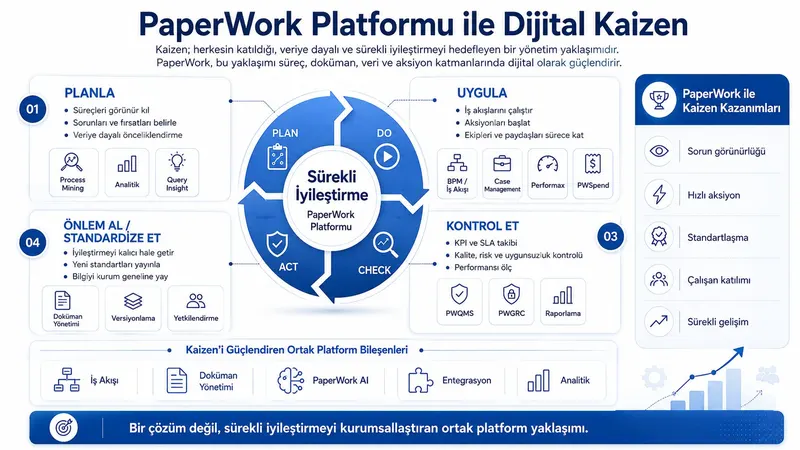
This is exactly where PaperWork's strength as a foundation for Kaizen begins. By bringing workflow, document management, process analytics, quality management, case management, risk management, integration and AI components together on the same platform, PaperWork places the continuous improvement cycle inside daily operations.
That is why PaperWork is not just a platform that digitalises processes. Used correctly, it becomes a digital improvement system that runs a Kaizen culture across the organisation.
What Kaizen needs is actually very clear: visibility
Improvement starts with seeing the problem. If the waiting time in a process cannot be seen, if it is unknown at which step a delay occurs, if the same error repeats in different departments but no one can track it as a whole, improvement remains only good intention.
This is where PaperWork makes its first major contribution: visibility.
Thanks to workflows, it is possible to track live which steps processes go through, who is holding which work, how long each approval takes, which request is at SLA risk and which action is delayed.
When Process Mining and process analytics come into play, this visibility grows stronger. How a process works in real life can be compared with how it was designed. Bottlenecks, repeated steps, waiting times, role-based workloads and SLA deviations come to light.
Kaizen's "first make the problem visible" approach becomes a measurable management practice with PaperWork.
An improvement idea creates no value unless it becomes an action
In a Kaizen culture, employees' suggestions are very valuable. But if a suggestion from the field, a nonconformity spotted by the quality team or an inefficiency noticed by a manager does not turn into action, the organisation misses a chance to learn.
One of PaperWork's greatest strengths is its ability to turn ideas and problems directly into actions.
An employee can enter a suggestion from the mobile app. A quality specialist can open a nonconformity record. A manager can link a risky process to an action. A customer complaint can be managed as a case. An audit finding can turn into a CAPA process.
More importantly, none of these actions is left without an owner. The owner, target date, priority, approval steps and follow-up mechanism become clear.
The hardest part of Kaizen in organisations is usually the question "Who will do what, and by when?" PaperWork makes this question systematic.
Kaizen is not only the quality team's job
In many organisations, Kaizen is perceived as an activity run by the quality department. Yet a true Kaizen culture is built with the participation of not only the quality team but also production, procurement, finance, human resources, IT, sales, suppliers and managers.
PaperWork's platform approach is very valuable in this respect.
Because PaperWork is not a solution for a single department. Quality management, risk management, contract management, expense and travel management, IT service management, case management, supplier processes and process analytics can all run on the same infrastructure.
What does this provide?
Improvement data created at different points in the organisation is not disconnected. A quality problem can be linked to an action, the action to a document revision, the document revision to a training process, and the training process to performance tracking.
In other words, PaperWork takes Kaizen out of being department-based work and turns it into a shared improvement language across the organisation.
Without standards, improvement does not last
One of the most critical points of Kaizen is standardisation. When a problem is solved, the work is not over. The real value comes when the solution found becomes the new standard.
This is where PaperWork document management comes in.
Procedures, instructions, forms, quality documents, policies and process descriptions are managed centrally. Revisions are recorded. A new standard goes through the necessary approvals before it is published. Old versions are preserved. Who can access which document is defined by permissions.
This structure is very important for Kaizen. Because for an improvement to last, information must reach the right people at the right time.
If a nonconformity keeps recurring, the problem may not be only operational. The instruction may be out of date. Training may be missing. The form may be designed incorrectly. The approval step may not be going to the right person.
Because PaperWork can make these connections, it manages not only the action side of improvement but also the standard side.
No Kaizen without measurement
In a Kaizen culture, good intentions are not enough. You need to measure.
After an improvement is made, the answers to these questions should be clear:
- Has the process really become faster?
- Has the waiting time decreased?
- Has the error rate dropped?
- Has SLA compliance increased?
- Has the workload become more balanced?
- Has customer or employee satisfaction improved?
- Does the same problem keep recurring?
PaperWork's reporting, dashboard and process analytics features make it possible to answer these questions with data.
For example, if there is a delay in a purchase approval process, Process Mining can show which step is creating the bottleneck. If the same nonconformity keeps recurring in a quality problem, root cause analysis can be carried out in PWQMS. If a risk action is delayed, PWGRC can make it visible. If a customer complaint is not closed on time, Case Management can bring it to the manager's screen.
The spirit of Kaizen is simple: Don't assume, measure. PaperWork makes this measurement part of daily work.
PWAI Assistant accelerates the Kaizen cycle
Data is important for Kaizen, but interpreting the data is just as important. Organisations often have enough data; the real problem is making sense of it quickly, prioritising it and turning it into action.
This is where PWAI Assistant makes a significant difference.
- It can summarise documents.
- It can simplify long explanations.
- It can interpret process data.
- It can prepare 5 Whys analyses for quality problems.
- It can support Pareto and fishbone analyses.
- It can create assessment reports for risks.
- It can generate risk scores for contract clauses.
- It can comment on process health.
- It can let users start work by natural language or voice.
This is very valuable for bringing Kaizen into everyday life.
Instead of filling in long forms, an employee can give instructions in natural language. Instead of reading scattered reports, a manager can receive a summary and risk signals. The quality team can create a first draft of a root cause analysis without spending hours. A process owner does not have to collect data from different systems to see a bottleneck.
PWAI Assistant is the shared intelligence layer that accelerates Kaizen.
How do PaperWork components work in the Kaizen cycle?
What makes PaperWork strong for Kaizen is not a single module but the platform components working together.
- Workflow Management: Runs improvement ideas, actions, approvals and follow-up processes.
- Document Management: Keeps standards, procedures, instructions and versions under control.
- Process Mining: Measures the real performance of processes and shows bottlenecks and improvement opportunities.
- PWQMS: Manages nonconformities, CAPA, actions, audits and quality analyses.
- PWGRC: Links risks, controls and actions to the continuous improvement cycle.
- Case Management: Manages operational problems, requests, complaints and cases on a single screen.
- Query Insight: Makes corporate knowledge accessible; provides natural-language access to procedures, policies and reports.
- Intelivus: Reduces manual data entry by reading documents and speeds up document-based processes.
- PWAI Assistant: Interprets data, summarises, makes suggestions and guides the user to action.
When these components work together, the Kaizen cycle becomes much clearer:
- See the problem.
- Start the action.
- Measure the result.
- Update the standard.
- Monitor again.
- Do better.
PaperWork takes Kaizen out of individual effort
If the success of Kaizen in an organisation depends on the interest, experience or follow-up of a few people, it is not sustainable. The improvement culture must be built into the system.
PaperWork plays an important role here.
- Because it records the improvement idea.
- It assigns the action to an owner.
- It makes delays visible.
- It updates the document.
- It measures performance.
- It monitors risks.
- It stores information.
- It interprets with AI.
- It turns the result into corporate memory.
This way, Kaizen stops being work carried by personal effort and becomes the organisation's way of doing business.
PaperWork is a platform made for Kaizen
For Kaizen to succeed, organisations need five things: visibility, action, measurement, standardisation and participation.
PaperWork brings these five areas together on a single platform.
- It makes processes visible.
- It runs actions.
- It measures performance.
- It manages standards.
- It involves employees in the process.
- It provides analysis and decision support with AI.
That is why PaperWork is not only a digital transformation platform. It is also a powerful Kaizen foundation that digitalises and institutionalises a culture of continuous improvement.
This is where the real difference for organisations emerges: with PaperWork, Kaizen stops being good intentions left in meeting notes and becomes an operating model that is measured, managed, tracked and continuously improved.
PaperWork doesn't just digitalise your processes. It helps you make them better every day.
Would you like to see PaperWork in your organization?
Request a Demo